Official Work Entry (DOI)
Light and Relic – A Contemporary Relic Provenance Work
https://doi.org/10.5281/zenodo.17560497
The Fine Art Print (1/3)
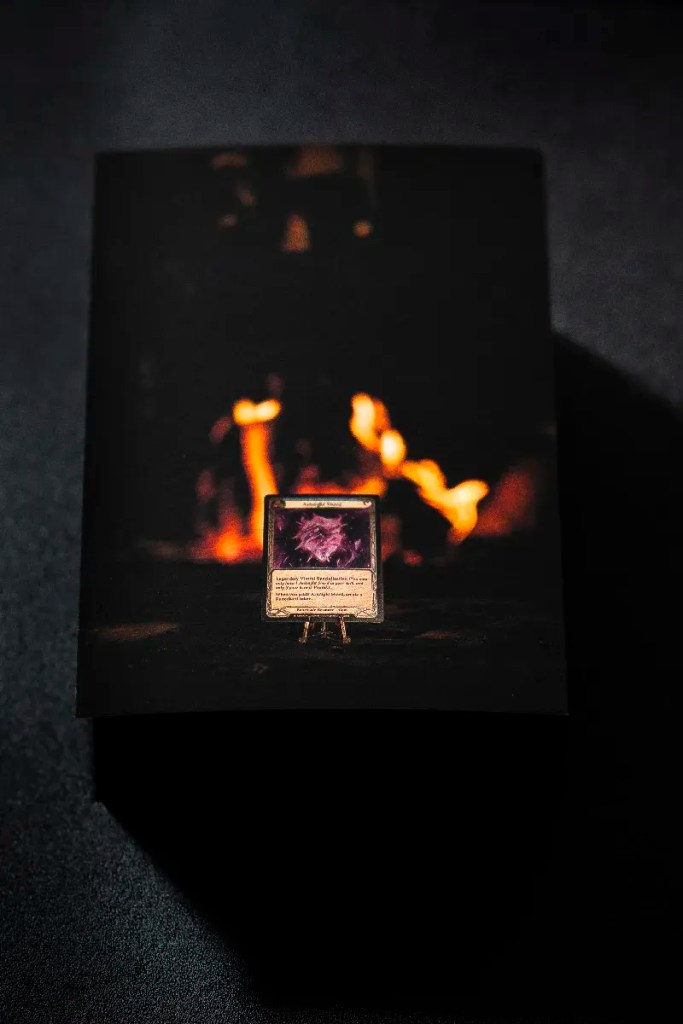
This fine art print (10×15 cm, Hahnemühle German Etching Pearl) depicts the Arknight Shard Cold Foil Fabled card (CRU000) from the trading card game Flesh and Blood. The photograph was created in 2025 in the forge of internationally recognized artist Andreas Rimkus, as part of the Light and Relic project by Sebastian Blume.
The work was produced in a strictly limited edition of three.
Limited to 3 prints, reflecting the pitch value of 3 on the Arknight Shard.
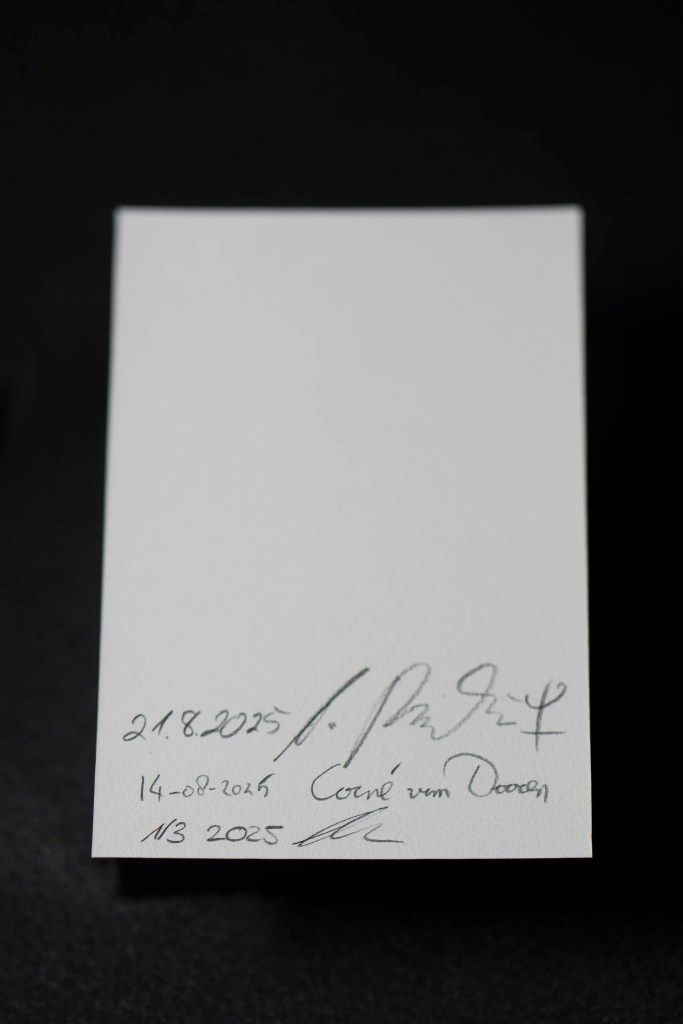
Fine Art Print 1/3 is the only copy bearing the signatures on the reverse of Sebastian Blume (photographer, initiator of the project)
Andreas Rimkus Andreas Rimkus (Forge Host, Blacksmith Artist)
Corné van Dooren (Kai of Cards, Netherlands).
Corné van Dooren is the store owner from whom the original card was drawn from a display in 2020. This draw is documented in detail in the blog entry about the Arknight Shard opening.
Kai of Cards was the first local game store in the Netherlands to support Flesh and Blood and one of the very first in Europe to import the game directly from New Zealand in late 2019.
The journey to Ederveen and the meeting with Corné van Dooren are described in the dedicated blog post: The Return to Kai of Cards – 700 Kilometers for the Arknight Shard Cold Foil.
Corné was one of the founders of the Netherlands FAB community, and is one of the members of FAB Five, a content creation team aimed at establishing local community, and creating content for players the world over.
Through the triple signature, Fine Art Print 1/3 becomes a central Living Provenance Relic of the Light and Relic project. It unites the artistic representation of the Shard with the documented origin of the card, marking the transformation of a gaming object into a cultural relic.
Provenance and Preservation Workflow
Light and Relic employs a multi-layered provenance and preservation workflow to ensure the long-term integrity of the Relic materially, temporally, and digitally:
Legal Work Fixation (Adobe FES, LTV-Enabled)
All verification documents are sealed using a qualified Adobe advanced electronic signature (FES) with long-term validation (LTV). Any modification would be cryptographically detectable and would invalidate the certification.
Temporal Anchoring (Decentralized Timestamping)
The existence and sequence of the project files are anchored via an independent, tamper-evident timestamp network. This ensures that provenance remains verifiable beyond any single institution or storage environment.
Long-Term Digital Preservation (PAR2, 25% Redundancy)
Recovery files with 25% redundancy are generated for both the master TIFF images and the FES-sealed PDFs, enabling exact bit-level reconstruction even in the event of storage degradation, media decay, or silent data corruption.
Embedded Provenance Metadata (IPTC / XMP)
The provenance of the work is embedded directly in the files themselves.
The Basic, Camera, Origin, IPTC, and IPTC Extension metadata fields are fully and consistently maintained as part of the artistic and archival process.
This embedded metadata layer records the context of creation, edition status, authorship, rights information, and documented moments of transfer and signature.
Because the provenance is contained within the file rather than stored in external documents, it remains reconstructable, verifiable, and persistent across copies, archives, and future storage environments.
The file is the archive.
Provenance is not attached from the outside — it is inscribed into the artifact itself.
Physical Archival Storage (M-DISC and Geographic Redundancy)
The files are additionally stored on long-duration archival media and preserved across separate physical locations to ensure continuity over extended periods of time.
This preservation model follows recognized archival preservation standards used in museums and research institutions.
It ensures that the provenance of Light and Relic remains permanently verifiable, stable, and reconstructable.
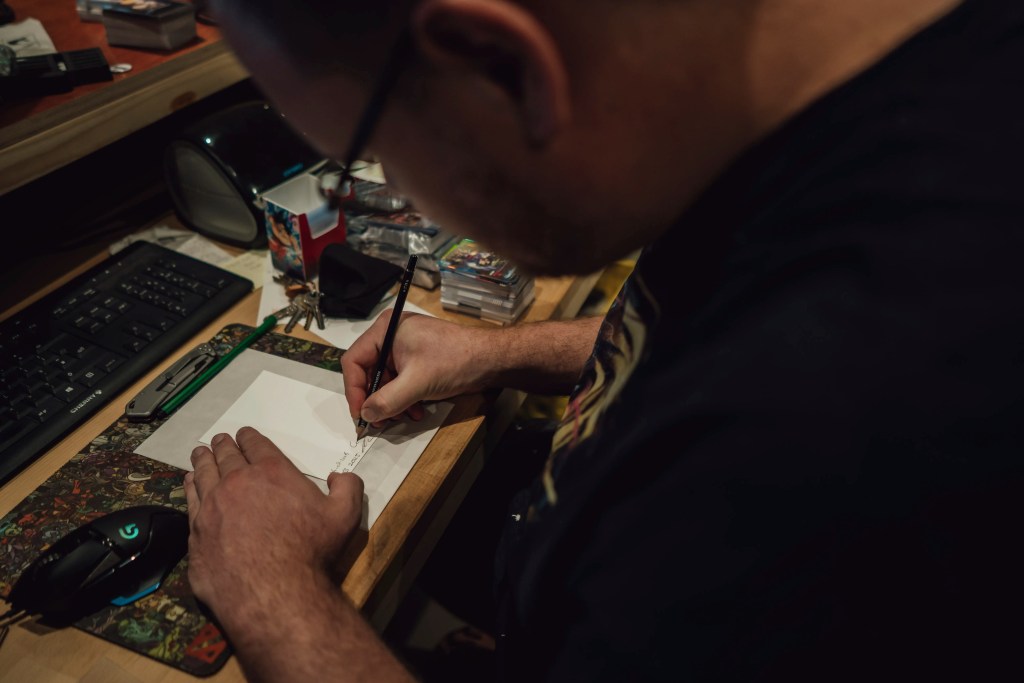
Corné van Dooren, owner of Kai of Cards and one of the founders of the Dutch Flesh and Blood community, signing the Fine Art Print 1/3 inside his store.
Cognitive Framework of Provenance
As part of the provenance documentation, the conceptual framework behind Light and Relic has been permanently archived on Zenodo, operated by CERN and connected to the international
DOI system.
This publication is also listed in the OpenAIRE research infrastructure and associated with the author’s ORCID iD, ensuring long-term verifiability and visibility within both artistic and academic contexts.
Reference
Blume, Sebastian (2023). Case Study – Structural Activation Analysis (SOZ).
Zenodo. https://doi.org/10.5281/zenodo.15976689
Blume, Sebastian (2025). Light and Relic – Conceptual Provenance Study.
Zenodo. https://doi.org/10.5281/zenodo.17524606
To ensure long-term redundancy and independent accessibility, a preservation mirror of the Light and Relic – Conceptual Provenance Study is stored on the Internet Archive:
Archive.org Mirror:
https://archive.org/details/light-and-relic-conceptual-provenance-study-sebastian-blume-2025
Light and Relic is a conceptual art project by Sebastian Blume, formally published via a master DOI.
It is not a franchise, game, or product line, but a provenance-based contemporary artwork.
The project transforms an existing cultural artifact through documentation, ritual, and archival methodology.