An Open Forge Day
Outside, voices filled the air. Visitors moved between the open forge areas where courses were taking place, iron was being struck, questions were asked and answered. Public activity remained outside.
Inside the forge, it was quiet.
The hearth was cold. The room was still.
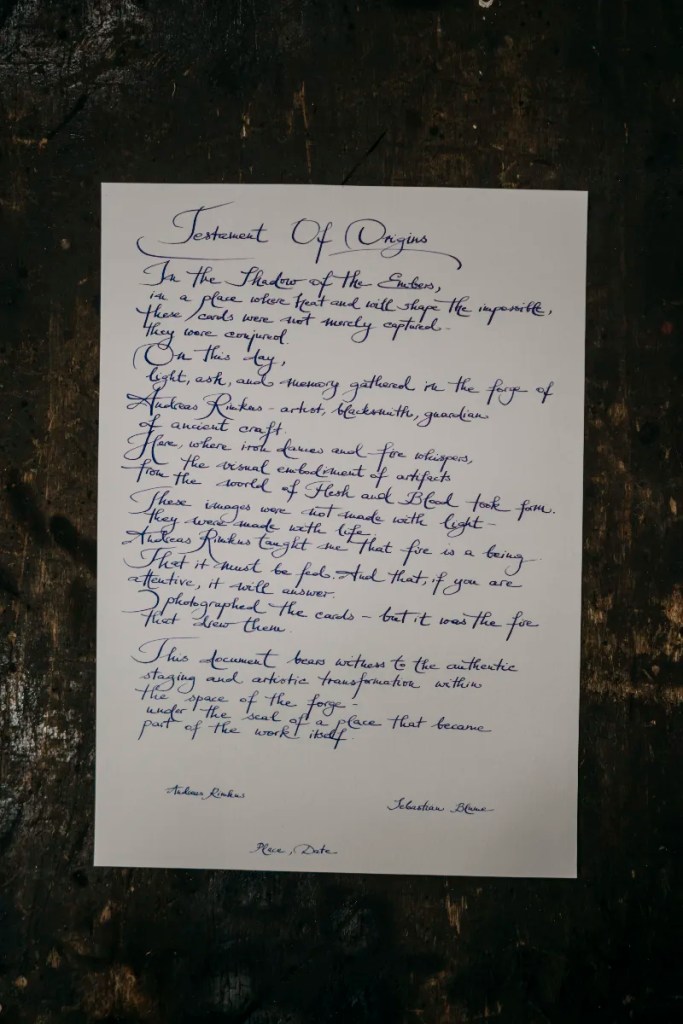
Andreas Rimkus handed me the document. Christine Rimkus, his wife, was not present that day; she had left the Testament of Origins there for me. No table, no staging, no prepared act. Just the transfer of a sheet of paper that already existed.
The document was fully written. The handwriting stood calm and clear on the paper. Everything required for the next step signature, seal, date was possible. But none of it happened.
I stood with Andreas in the room. Outside, the day continued. Inside, it remained still.
“Let’s sign on another day,” he said.
It was not a refusal. It was a decision for the work.
Not out of uncertainty, but out of care.
A signature on a day that was not quiet would not have done the document justice. An act that requires attention should not take place between other proceedings.
“We’ll sit down for this in peace,” he said.
The pen remained untouched.
The seal remained unformed.
Time as a Prerequisite
That this document required time did not become apparent only on that day.
Its coming into being followed no fixed schedule.
Several months passed between the initial request and the moment the text was written. There was no appointment, no pressure, no reminders. The text was not meant to exist because it was needed, but because a moment arrived in which writing felt right.
Christine decided herself when to take up the pen.
A Conversation Before the Document
Between the request and the finished text, there was another moment.
We sat inside, quietly. Tea stood on the table. The forge was still. There was no occasion, no time pressure.
I spoke about what had accompanied me over the past year not in detail, not as a chronology, but as experience: of situations in which procedures outweighed people, of moments of being left alone, and of how Light and Relic emerged precisely from this situation.
Christine listened.
Without interrupting. Without classifying.
Only in this conversation did I ask her to write the document. Not because of the handwriting alone even though it is beautiful but because I sensed in her a depth and an understanding of the process that did not need to be explained.
Archival Record: [Archive.org]
Documented, but Not Executed
Once it was clear that this day was not the right one for signing, I took time for a different engagement with the document.
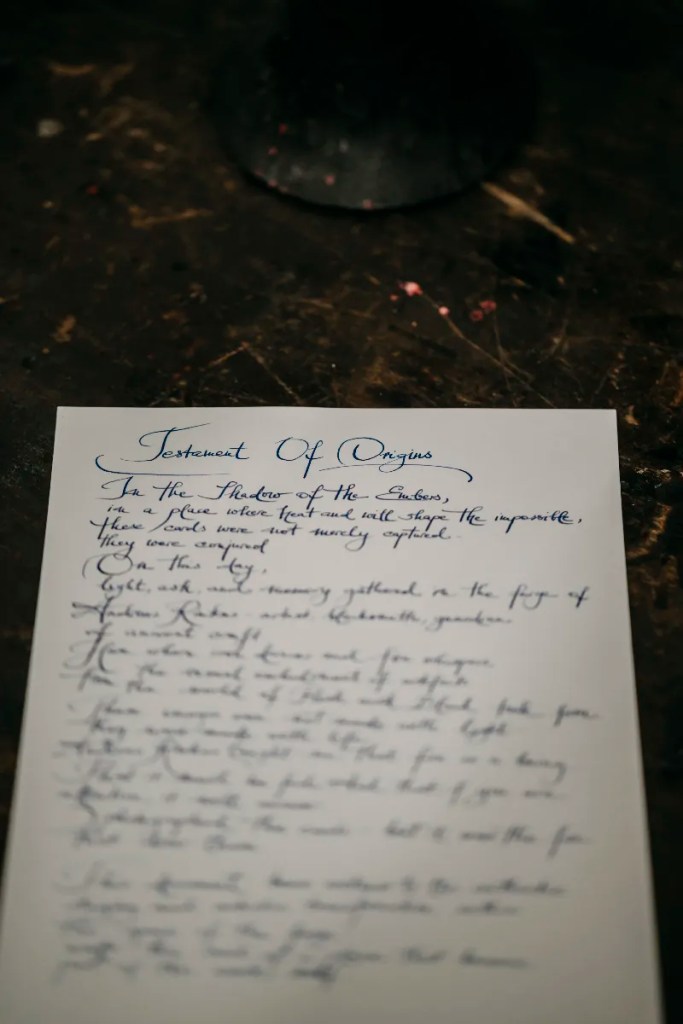
With permission, I photographed the Testament of Origins in the forge. Not as a completed act, not as proof, but as a state. The document was present at its place of origin before it was formally executed.
Without signature.
Without seal.
Without date.

Wiki Common Source Brand Seal from the Testament of Origins
On Waiting
In a world that presses for immediate results, waiting is often read as delay. Here, it was a form of respect.
Not everything that is ready must be carried out immediately. Some things gain weight precisely by being given time.
The document remains unexecuted.
The seal has not yet been chosen.
The moment is still pending.
This, too, is what I understand as Living Provenance not as theory, but as a sequence of decisions that remain visible. Including the decision not to act.
Leave a Reply